Bee bread vs bee pollen: what’s the difference?
Bee bread and bee pollen come from the same place, flowers, but they’re not the same product.
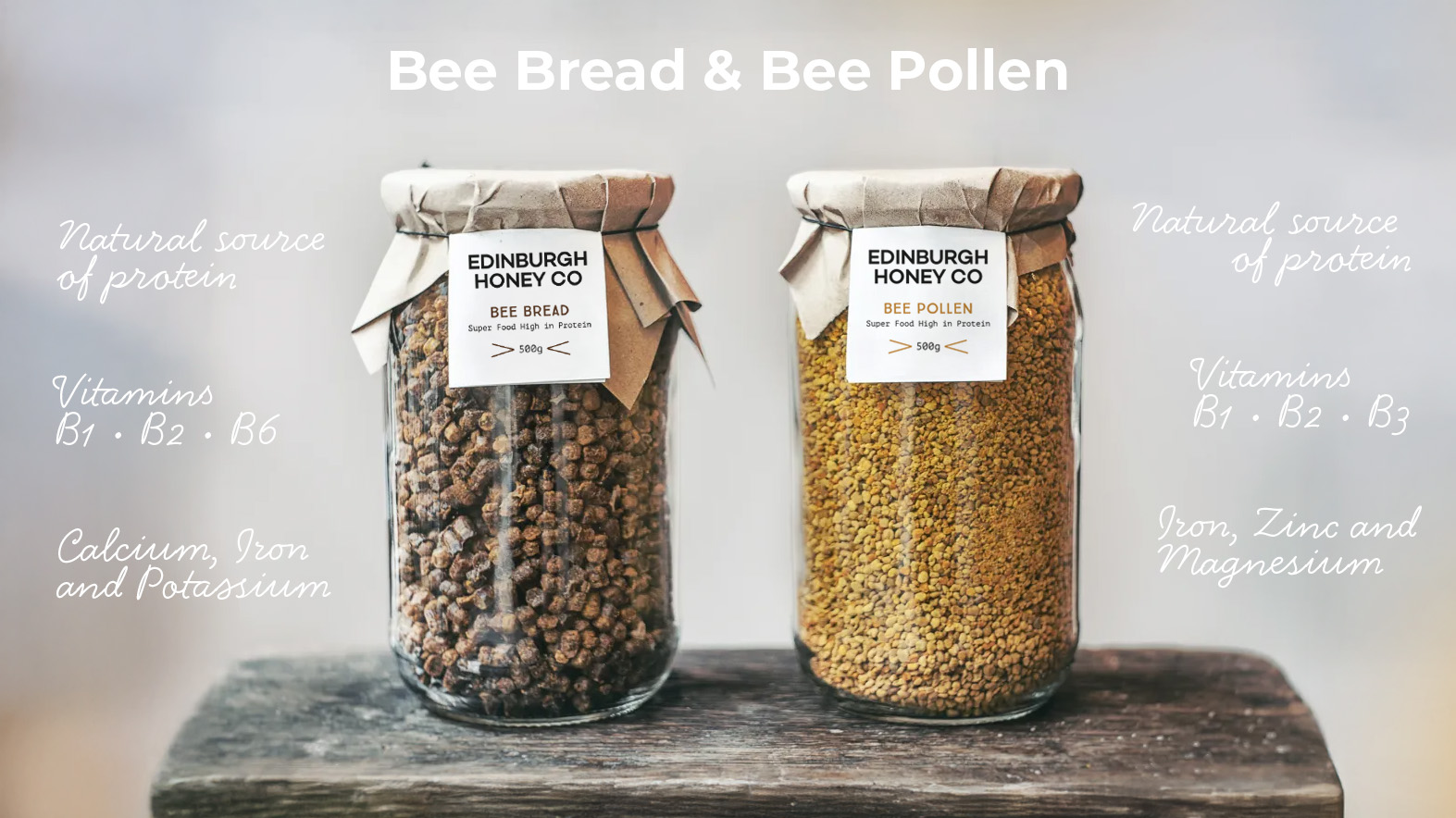
Bee pollen is collected by bees and brought back to the hive as pellets. Bee bread is what happens next: bees store that pollen in the comb and it undergoes natural fermentation. This process changes the structure, acidity, flavour, and potentially how easily some nutrients are released from the pollen wall.
In this guide, we’ll explain what each one is, how bees make them, what research says at a high level, and how to decide which is the better fit for you.
What is bee pollen?
Bee pollen is flower pollen collected by worker bees. As they visit blooms, pollen sticks to their bodies and is packed into small pellets (often called pollen loads) before being carried back to the hive.
It’s naturally complex: pollen contains a mix of macronutrients (such as carbohydrates and proteins), along with vitamins, minerals, fatty acids, and plant compounds that vary depending on floral source and season.
In simple terms: bee pollen is the “fresh” ingredient.
What is bee bread?
Bee bread (sometimes called perga) is pollen that has been stored and transformed inside the hive.
Bees pack pollen into honeycomb cells, mix it with honey or nectar nectar and naturally occurring enzymes from the bees, to seal it in wax. Inside this low-oxygen environment, the stored pollen undergoes lactic-acid fermentation involving naturally present microbes.
In simple terms: bee bread is the fermented version of bee pollen.
Why fermentation matters (the science-led bit)
Fermentation isn’t just a buzzword, it’s a real biological process that changes food.
In the hive, fermentation helps:
- Preserve pollen stores for later use
- Shift the chemistry of sugars and acids
- Alter pollen structure, which is why bee bread is often described as easier to digest (individual experience varies)
This process is also why bee bread tends to taste more tangy than bee pollen.
Bee bread vs bee pollen: the practical differences
1. How they’re made
- Bee pollen: collected from flowers and brought back to the hive
- Bee bread: pollen that bees have stored, packed, sealed, and fermented in comb cells
2. Texture and taste
- Bee pollen: dry, crunchy granules with a mild floral taste
- Bee bread: softer or chewier granules with a deeper, tangier flavour
3. Nutrient profile (broadly)
Both are nutrient-rich and naturally variable by region and forage. Research comparing them highlights differences driven by fermentation, including changes in sugars, acids, and some vitamins and lipids.
- Bee pollen: closer to original plant pollen
- Bee bread: pollen processed by the hive
4. Why people prefer one over the other
- Bee pollen: easy to sprinkle into yoghurt, porridge, smoothies
- Bee bread: suited to fermented-food routines and smaller, slower use
Which should you choose?
Choose bee pollen if you want:
- A light, easy sprinkle
- A mild taste
- A simple daily breakfast add-on
Choose bee bread if you want:
- A fermented hive food
- A richer, tangier flavour
- Something you’ll use in smaller amounts
Or use both: some people keep both and use them differently — pollen for sprinkling, bee bread as a small, concentrated spoonful now and then.
How to take bee bread and bee pollen
Bee pollen (easy options)
- Sprinkle over yoghurt, kefir, porridge, granola
- Blend into smoothies
- Stir into overnight oats
Bee bread (easy options)
- A small spoonful on its own, followed by water
- Stir into yoghurt or kefir
- Take with a spoon of honey
- Add to overnight oats
Tip: avoid mixing either product into very hot drinks — gentle use is best.
A responsible research note
Bee bread and bee pollen are traditional hive foods that have been part of human diets for generations. Research into these products focuses on their natural composition and, in the case of bee bread, how fermentation transforms pollen inside the comb. As with many whole and fermented foods, results vary depending on botanical origin, production methods, and context of use, and human evidence for specific outcomes is still developing.
Bee bread and bee pollen aren’t medicines, and they’re not intended to diagnose or treat any condition. If you have allergies, are pregnant, or are managing a health concern, it’s sensible to speak with a qualified professional before adding new bee products to your routine.
This article was informed by academic research exploring the natural fermentation of pollen by bees, as well as broader research into hive-based foods and fermentation. If you’d like to explore the research context further, the following publications offer useful starting points:
Further reading
Bee pollen and bee bread comparative overview (open access)
https://pmc.ncbi.nlm.nih.gov/articles/PMC9862147/
Vásquez, A. & Olofsson, T. C. (2009)
The lactic acid bacteria involved in the production of bee pollen and bee bread.
Journal of Apicultural Research.
https://doi.org/10.3896/IBRA.1.48.3.07
Bakour, M. et al. (2019)
Bee bread as a functional product: Chemical composition and bioactive properties.
LWT – Food Science and Technology.
https://www.sciencedirect.com/science/article/abs/pii/S0023643819300908
Kieliszek, M. et al. (2018)
Pollen and bee bread as new health-oriented food products: A review.
Trends in Food Science & Technology.
https://www.sciencedirect.com/science/article/abs/pii/S0924224417301681
[…] Read next: Bee Pollen blog | Bee Bread Vs Bee Pollen […]